



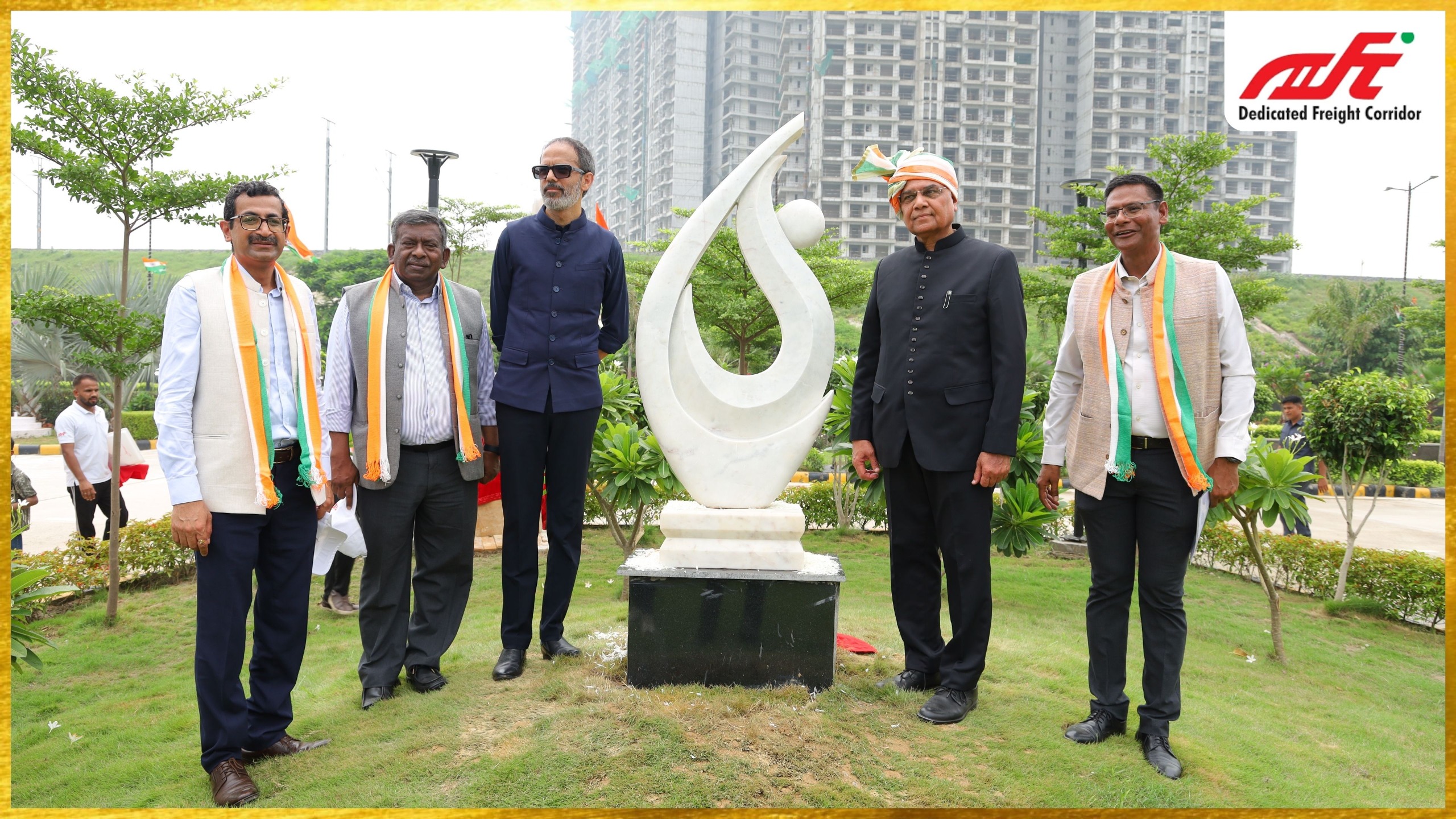

The Dedicated Freight Corridor Corporation of India Limited (DFCCIL) celebrated the 80th Independence Day at its Corporate Office in Sector-145, Noida, with enthusiasm and patriotic spirit. Shri Praveen Kumar, Managing Director, DFCCIL, was the Chief Guest on the occasion. He paid tribute to the freedom fighters and remembered their courage and sacrifices that continue to inspire nation-building.
The programme featured the singing of the national song “Vande Mataram.” The Track Recording Car (TRC), OHE Recording Car (ORC), and Bridge Inspection Vehicle (BIV) were launched as new initiatives. These advanced inspection assets will significantly strengthen infrastructure monitoring and maintenance across the DFC network and mark an important step towards DFCCIL’s transition to a predictive maintenance regime, enhancing asset reliability, safety and operational efficiency.
The occasion also witnessed the release of DFCCIL’s updated History Book, Coffee Table Book, book on CTP-14, Land Manual and Hindi MOP (Manual of Procedure). A commemorative postal stamp issued by India Post to celebrate the commissioning of the entire DFC network was also unveiled, marking this landmark achievement in India’s freight transportation history.
Green and Technological Infrastructure Inaugurated
A nursery and solar system were inaugurated at the Corporate Office Complex, along with Anand Van based on the Miyawaki plantation method, Unnati Udyan, Herbal Garden and Amrit Vatika. The Experience Centre and Building Management System were also inaugurated. These initiatives will promote green development and contribute to a modern and improved workplace environment.
Achievements of the DFC Network
The year 2025-26 marked several important achievements. With the commissioning of the Vaitarna-JNPT section on 31 March 2026, the Dedicated Freight Corridor network became fully operational. The DFC network is now playing an important role in ensuring the supply of essential commodities across the country and improving freight transportation.
During 2025-26, a total of 1,47,993 freight trains were operated, around 14 percent higher than the previous year. The average number of trains operated per day increased from 356 to 406, while a maximum of 460 trains was recorded. With the DFC accounting for only 4 percent of the Indian Railways network, it now carries 14 percent of the country’s total rail freight. Continued focus is being placed on improving reliability, availability, safety, speed, throughput and customer satisfaction across the network.
Focus on Technology and Research
The increasing use of technology in maintenance and operational processes is driving a shift from preventive to predictive maintenance and from reactive to data-driven decision-making. The International Heavy Haul Seminar, held in June 2026, brought together experts from across the world to share knowledge, best practices and innovations. The initiative further strengthened DFCCIL’s position as a “Centre of Excellence” in the heavy-haul transportation sector.
To promote technological modernisation, partnerships have been established with IIT Roorkee, IISc Bengaluru, Monash University, ICFAI Foundation for Higher Education and L2M Rail. These collaborations have accelerated advanced research in areas including broken rail detection, machine vision inspection, wheel-rail interface, heavy-haul operations and logistics.
Cargo Terminals and Infrastructure Development
The DFC is being further integrated with India’s logistics ecosystem through Gati Shakti Cargo Terminals, private sidings, industrial and port connectivity, and logistics hubs. Seven Gati Shakti Cargo Terminals have been operationalised so far.
Several important infrastructure projects were completed on the DFC network during the past year. These include crew facilities at DDU, New Kanpur, Palanpur and New Ateli, track machine depots at Ajmer and Makarpura, and 20 Railway Over Bridges (ROBs) along with other connectivity-related projects.
In addition, DFCCIL has been selected as a finalist in the “Mega Projects” category of the FIDIC 2026 Project Awards. It is the only Indian project to reach the final in this category. The recognition reflects global appreciation for DFCCIL’s contribution to sustainable infrastructure and its social, economic and environmental impact.
Safety and Jan Rakshak Initiative
Safety continues to remain the highest priority in operations. No operational target, deadline or requirement is placed above safety. The Ministry of Railways has appreciated DFCCIL’s “Jan Rakshak Initiative” and advised all Zonal Railways to study the initiative and consider its implementation within their respective jurisdictions.
Focus on Green and Sustainable Development
The organisation is also focusing on developing a greener and more sustainable DFC through renewable energy, solar power, water conservation, plantation and efficient utilisation of resources. Better integration of technology, modern infrastructure and human resources is helping strengthen operational efficiency and long-term development.
The programme concluded with appreciation for the contributions of officers and employees, contractors, consultants, suppliers, technical partners, Indian Railways colleagues and other stakeholders. The organisation reiterated its commitment to safety, technological modernisation, continuous improvement and environmental protection while contributing to the vision of “Viksit Bharat.”

